
Problem and core assumption
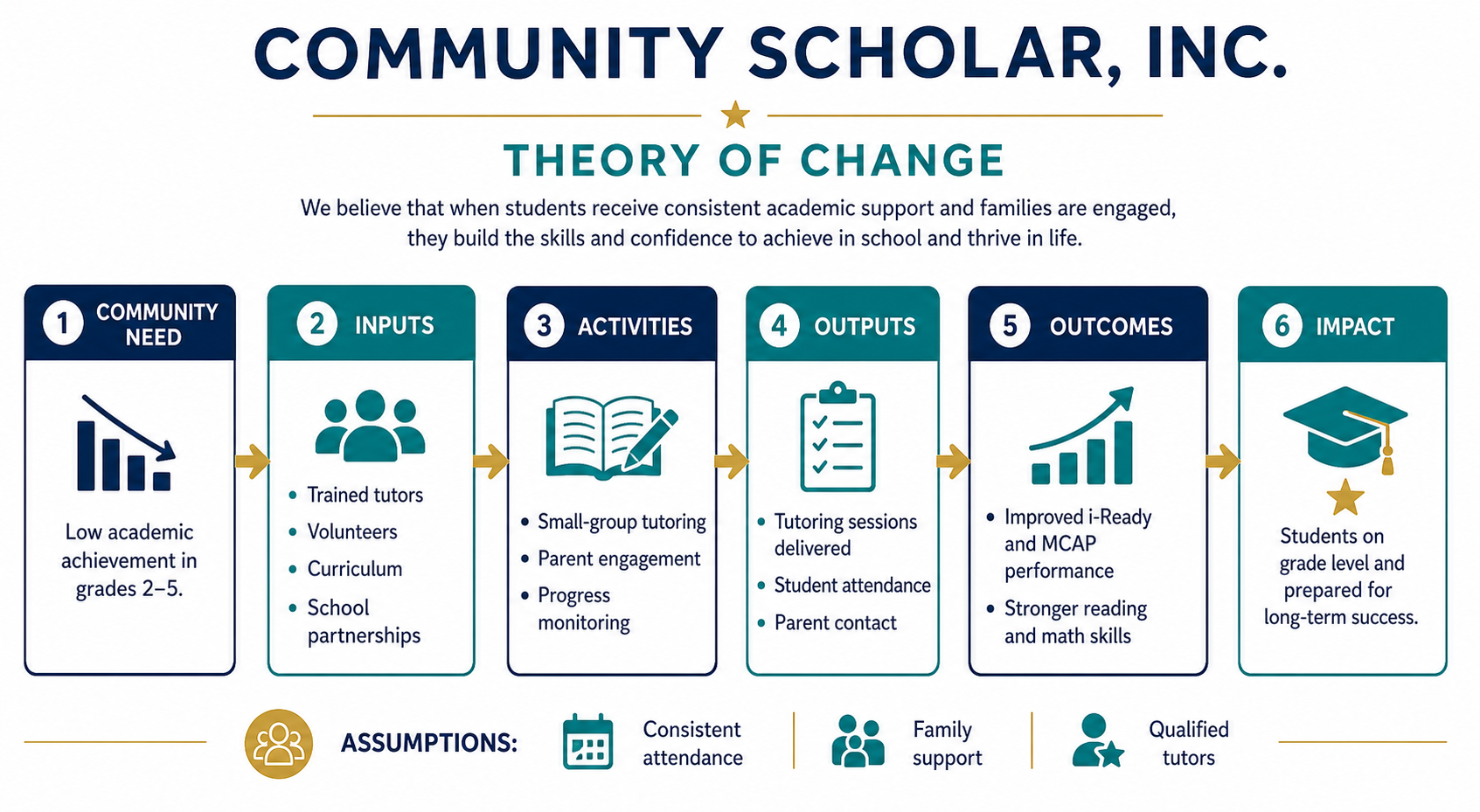
Many students, particularly those from under-resourced communities, struggle to meet grade-level expectations because academic support is fragmented across school, home, and community. Community Scholar is based on the assumption that when schools, families, tutors, and community partners work in a coordinated way around clear learning goals, students receive consistent, high-quality support that accelerates both achievement and confidence.
Inputs
Community Scholar leverages tutors, engaged parents and caregivers, classroom teachers and administrators, a clear curriculum aligned to classroom standards and assessments (e.g., iReady, MCAT), dedicated program leadership, and community-based spaces and technology. These resources provide the capacity to offer relationship-based, small-group or one-on-one tutoring that is tightly linked to what students are learning in class.
Activities
The program identifies students’ needs using school data and assessments, then matches them with tutors who provide regular, structured tutoring sessions after school. Tutors use aligned lesson materials and sample test items to reinforce classroom instruction. The program also communicates regularly with parents, teachers, and administrators, sharing goals, progress, and strategies so that expectations are consistent at home, in tutoring, and in class. In addition, Community Scholar offers orientation and ongoing support to families so they understand how to support learning and use available resources.
Outputs
In the short term, Community Scholar delivers measurable activity: students receive a defined “dose” of tutoring (for example, multiple sessions per week over an extended period), tutors are trained and supported, families are contacted and engaged, and teachers receive timely information about student progress and program focus. These outputs are tracked as numbers of students served, sessions delivered, tutors trained, and families engaged.
Outcomes (short- and medium-term)
In the short term, students show improved attendance in tutoring, greater engagement in class, stronger foundational skills in targeted subjects, and increased familiarity with the types of questions and tasks they will encounter on key assessments. Families report better understanding of school expectations and greater confidence in supporting homework and study. Over the medium term, students’ grades and assessment scores improve, learning gaps narrow, and teachers see higher levels of participation and persistence, particularly among students who were previously struggling.
Long-term impact
Over time, Community Scholar expects to increase the proportion of students meeting or exceeding grade-level standards, reduce the number of students requiring intensive remediation, and strengthen the overall culture of shared responsibility for academic success. As successive cohorts benefit from aligned tutoring and family-school-community collaboration, students are better prepared for advanced coursework, high-stakes assessments, and future educational opportunities, contributing to higher graduation rates and expanded postsecondary options such as college, the military or trade schools.